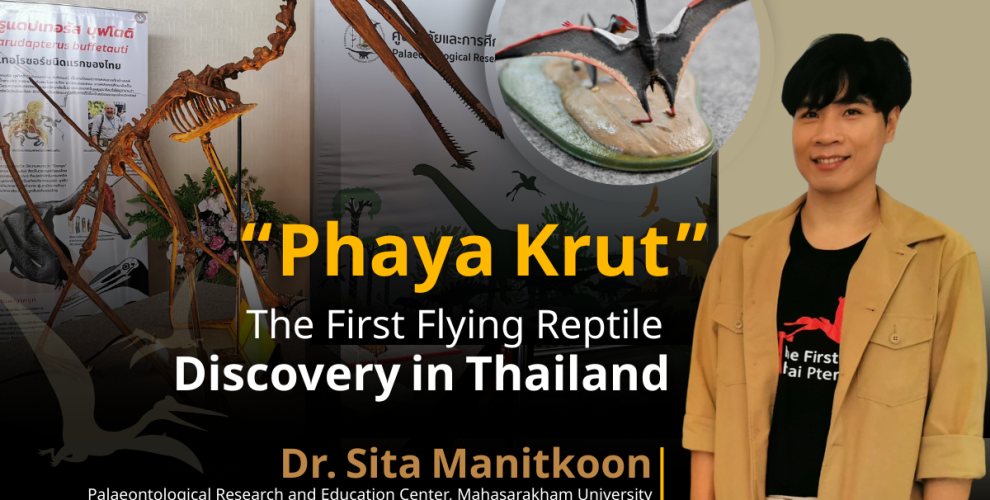
A groundbreaking discovery that has captured the attention of both Thai and international scientific communities was made when Dr. Sita Manitkoon, a researcher at the Palaeontological Research and Education Center, Mahasarakham University, unearthed a new species of flying reptile fossil. This fossil, dating back more than 130 million years, has been named “Phaya Krut”, marking the first record of a flying reptile found in Thailand and Southeast Asia.
The significance of this discovery extends beyond simply adding a new species to the scientific record. Phaya Krut serves as vital evidence that sheds new light on prehistoric ecosystems in the region and highlights Thailand’s growing role in paleontological research at the international level.

The Historic Discovery
This major finding occurred when Dr. Sita Manitkoon and his team identified fossil remains of a previously unknown flying reptile species. The fossil is over 130 million years old and represents the first confirmed evidence of its kind in Thailand and Southeast Asia.

The Beginning of the Discovery
Paleontological research in Thailand has made steady progress, particularly in the Northeast, known for important dinosaur and coexisting animal fossils. However, Sakaeo Province in the East also drew attention, as fossil remains were reported there as early as 2002 but had not been thoroughly studied. Two years ago, Dr. Sita’s team revisited the site and uncovered mysterious fossil fragments that became the starting point of this historic discovery.

Characteristics of the Fossil
The fossil includes parts of a skull, jaw, and teeth. Detailed examination showed they did not match dinosaurs or other known reptiles. Anatomical analysis confirmed that it belonged to the group Pterosaur—flying reptiles that lived alongside dinosaurs around 130 million years ago. This is the first confirmed evidence of pterosaurs in Thailand and Southeast Asia.

Naming “Phaya Krut”
The new species was given the scientific name Garudimimus, derived from Garuda—a mythical bird-like creature in regional beliefs and culture—combined with the Greek word pteros, meaning “wing.” The name can be translated as “wings of the Garuda.” The species epithet also honors a French paleontologist who played a pioneering role in paleontological research in Thailand. The popular name “Phaya Krut” was chosen to make the discovery more accessible and relatable to the public.

Significance of the Discovery
As the first flying reptile discovered in Thailand and Southeast Asia, Phaya Krut confirms that Thailand was once a habitat for pterosaurs. The fossil is a crucial piece of evidence for reconstructing dinosaur-era ecosystems. It has also sparked interest both academically and among the general public, since pterosaurs are widely familiar through films and popular prehistoric media.

Research and International Collaboration
Although only a few fossil fragments were found, collaboration with researchers from China and Brazil—experts in pterosaurs—helped confirm that it represents a new species to science. The research took about one year to complete and was published in an international scientific journal in March.

Extending the Discovery to Society
The discovery of Phaya Krut has not been limited to academia. It has been shared with the public through youth camps, training workshops, and exhibitions in collaboration with museums across the country. In this way, the fossil has become a bridge for promoting paleontology in society and inspiring greater interest in science among the younger generation.

A Message to the Public
Paleontology studies extinct life forms, but it is never outdated—it is a window into understanding Earth and nature in the past. The discovery of Phaya Krut is not only a source of pride for Thai researchers but also a reflection of the nation’s scientific potential. Most importantly, it serves as inspiration for young people to explore, research, and seek new knowledge hidden beneath Thai soil.

For more information, please contact:
Dr. Sita Manitkoon
Palaeontological Research and Education Center,
Mahasarakham University