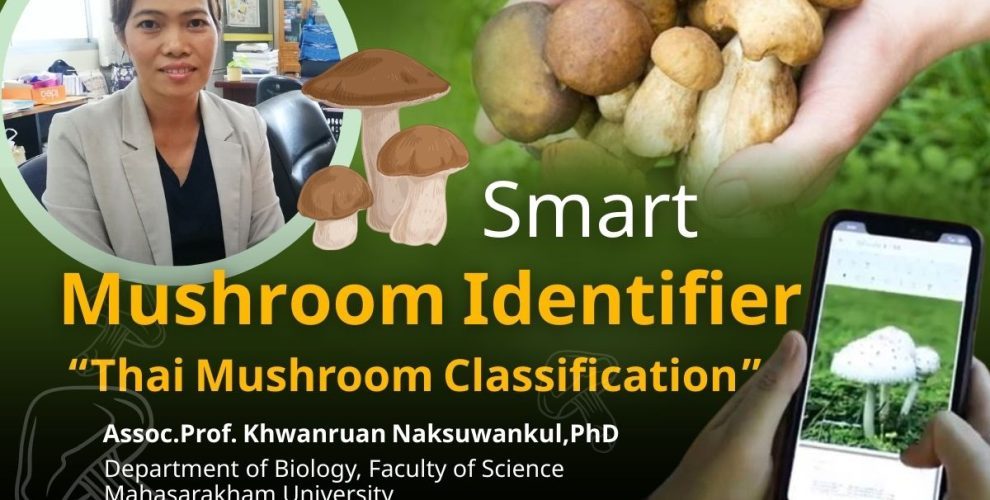

Thailand is rich in biodiversity, especially in rural areas where people still rely on natural resources in daily life. Collecting wild mushrooms for food has long been a part of local culture. However, this practice carries risks, as many poisonous mushrooms cannot be distinguished by sight alone and may cause fatal poisoning.
In response to this issue and the urgent need for quick, reliable access to information, a research team from Mahasarakham University, in collaboration with researchers from the Department of Medical Sciences, Ministry of Public Health, has developed the application “Thai Mushroom Classifier”—an app created by Thais, for Thais.
This application serves as a tool to help accurately identify mushroom species using artificial intelligence (AI) combined with a database of mushrooms found in Thailand. The goal is to create an innovation that not only enhances public safety but also promotes sustainable learning about natural resources.
Beyond ensuring safe consumption, the application extends biological and information technology knowledge into practical use in everyday community life. This article will take readers through the background, concept, and benefits of this important research project.

The project was carried out under the research initiative “Integrating Databases into Innovation: Application Mushroom Image Matching for Poisonous and Edible Mushrooms (2017–2020)”, based on a Memorandum of Understanding (MoU) on academic collaboration between the Department of Medical Sciences, Ministry of Public Health, and the Natural Medicinal Mushroom Museum, Faculty of Science, Mahasarakham University. The project was led by Assoc. Prof. Khwanruan Naksuwankul, PhD, a faculty member in the Department of Biology, Faculty of Science, Mahasarakham University.
Title: Application for Mushroom Identification: “Thai Mushroom Classifier”
Background of the Application Development
The idea for developing the “Thai Mushroom Classifier” application arose from the increasing number of poisoning cases caused by toxic mushrooms. According to reports from the Bureau of Epidemiology, Department of Disease Control, Ministry of Public Health, over the past five years the number of people consuming poisonous mushrooms has continued to rise each year. More than 30 deaths and over 6,000 poisoning cases have been recorded.
When cases of mushroom poisoning occur, local medical officers—such as those at subdistrict health promotion hospitals (RPHs) or general hospitals—must conduct disease investigations. This involves collecting leftover food or mushroom samples to be sent to the Department of Medical Sciences for toxicology analysis. The results are then sent back to hospitals so physicians can provide proper treatment.
These circumstances raised an important question: How can we reduce the number of patients affected by poisonous mushroom consumption?

Key Features of the “Thai Mushroom Classifier” Application
The “Thai Mushroom Classifier” application is convenient and easy to use—anyone can access it. Simply download the app onto an Android smartphone, and once installed, it can even function without an internet connection. Users do not need any prior knowledge about mushrooms; the app can be used immediately to help identify them.
When a user scans a mushroom to identify its species, the application processes the image in real time by comparing its morphological features with photos stored in the database. The accuracy of the match is displayed as a percentage. Once the similarity reaches 95%, the program stops and displays the mushroom’s image and name on the screen, showing the two closest species.
If the scanned mushroom is poisonous, a red skull logo will appear as a warning. If the mushroom is edible, the app shows a green fork-and-spoon logo. Users can also tap for more details, including local and scientific names, key identifying features, toxin groups, symptoms of poisoning, and first-aid guidelines in case of mushroom intoxication.

How to Use the “Thai Mushroom Classifier” Application
Using the “Thai Mushroom Classifier” app is very simple. When you come across a mushroom and are unsure of its type, just open the app and scan the mushroom. The app will process the image by comparing it with photos in its database. The steps are as follows:
Download Options
- Search for “คัดแยกเห็ดไทย” on Google Play.
- Scan the QR code.
How to Use
- Open the app.
- Register to use the application.
- Open the camera to scan the mushroom you want to identify.
- The program will analyze the image and stop when the accuracy level reaches 95%.
- The app will then display the results: if the mushroom is poisonous, a red skull icon will appear; if it is edible, a green fork-and-spoon icon will appear, along with the mushroom’s name.
- Tap the name for additional information, such as local and scientific names, characteristics, toxin groups, poisoning symptoms, and first-aid guidelines.
- Once installed, the application can be used offline, without an internet connection.
Future Development Plans for the “Thai Mushroom Classifier” Application
The core of this application lies in having an accurate and extensive mushroom database with a large number of images for comparison. The more comprehensive the database, the more effective and precise the app will be. With a limited number of images, the accuracy of mushroom identification decreases.
Currently, the application functions well, but the research team aims to enhance its performance further. The key priority is to expand the database. At present, the app contains 14 groups of edible and poisonous mushrooms. In the future, the researchers plan to add more species found in natural forests and mushrooms commonly sold in local markets during the rainy season—excluding cultivated mushrooms from farms—since the application is designed mainly for identifying wild mushrooms.

Challenges in Developing the “Thai Mushroom Classifier” Application
In the first version of the application, all available mushroom images were placed into the database. However, this caused the program to process very slowly. Another issue was the unequal number of images for each mushroom species. As a result, when the app scanned mushrooms from species with fewer reference images, the comparison sometimes failed to match correctly—even if it was the same species. Instead, the program tended to compare features with species that had a larger number of images in the database.
After reviewing the issues, the team decided improvements were needed. The research team’s programmer suggested using 1,000 images per mushroom species, with an equal number of images for each species, to avoid bias in the comparison process. This led to the development of Version 2 of the application.
Later, Version 3 was introduced, which allowed the program to identify mushrooms not only through real-time scanning but also by uploading photos received on mobile phones for analysis. However, this version encountered problems: when images were uploaded, they sometimes appeared upside down or distorted, causing errors in the comparison process. As a result, Version 3 was discontinued and is awaiting further improvement. At present, Version 2 remains the active and functional version of the application.

Additional Obstacles in the Research Process
Another challenge faced during the project was the unpredictable growth of mushrooms each year. For example, a poisonous mushroom species might appear around mid-July one year, but when the team returned the following year to collect more samples and photographs in the same location, none were found. In some cases, during scheduled fieldwork, mushrooms were absent because of a lack of rainfall, or they had already decomposed.
Since the research team needed to conduct fieldwork across the country, especially in areas with reported mushroom poisoning cases, they often had to race against time to collect as much accurate and complete data as possible.
Plans to Transfer the “Thai Mushroom Classifier” Application to Communities
At present, the research team has organized training workshops on mushroom morphology and the use of the “Thai Mushroom Classifier” application. To support this, the project produced a manual titled “A Guide to Mushroom Morphology, Poisonous Mushrooms, and Community Surveillance” for both general learners and training purposes.
Initial training sessions have targeted community health workers, including village health volunteers (VHVs) and staff at Subdistrict Health Promotion Hospitals (RPHs). VHVs are often the first to detect cases of mushroom poisoning in their communities and report them to RPH staff. These staff members then conduct detailed disease investigations, collect leftover food or mushroom samples, and send them to the Department of Medical Sciences for toxin identification. The results are returned to hospitals so physicians can provide appropriate treatment.
For this reason, the “Thai Mushroom Classifier” application is being introduced to VHVs and RPH staff. They can use it both to assist villagers directly and to pass on knowledge. If community members do not own smartphones, VHVs or RPH staff can scan mushrooms on their behalf before they are cooked, helping reduce the risk of poisoning.

Integration into University and School Education
At the university level, the “Thai Mushroom Classifier” application has been incorporated into courses within the Department of Biology. Through these courses, students learn about edible and poisonous mushrooms and the dangers of mushroom poisoning. Students who practice using the application also serve as important messengers, sharing their knowledge and demonstrating the app’s use within their families and communities.
In addition, the Faculty of Science has supported the establishment of science classrooms in secondary schools under the supervision of the university, known as the Science Classroom Project (MWIT Program) at Mahasarakham University Demonstration School. In this program, courses such as Science and Local Wisdom are offered. As part of this course, lessons on local mushroom knowledge—both edible and poisonous—and the use of the “Thai Mushroom Classifier” application are taught. This enables students to study local mushrooms and raises awareness for monitoring wild mushroom consumption in their families and communities in the future.
University Support for the Research
Special thanks are extended to Mahasarakham University for its strong support of this research, carried out under the MoU between Mahasarakham University and the Department of Medical Sciences, Ministry of Public Health.
The university also houses the Natural Medicinal Mushroom Museum at the Faculty of Science, which plays an important role in supporting teaching and research. The museum contains preserved mushroom specimens, both dried and stored in solution, as reference materials. It also features exhibition displays open to visitors, along with a database of mushroom species, scientific names, images, physical characteristics, and habitats—data collected over decades of field surveys across the country.
This extensive knowledge base provided essential resources that contributed to the development and improvement of the “Thai Mushroom Classifier” application.

Message for Young Researchers
I would like to encourage all young researchers to find a field of study they truly love and are passionate about. Commit yourself to that work with clear goals and enjoy the process. Seek colleagues who share the same passion, as working together with like-minded people makes the journey even more meaningful.

For More Information, Please Contact:
Assoc. Prof. Khwanruan Naksuwankul, Ph.d.
Department of Biology, Faculty of Science
Mahasarakham University
Tel. 043-754247–8 or
Division of Public Relations and International Affairs
Tel. 043-754315
Original Article: แอปพลิเคชั่นตรวจสอบเห็ด “คัดแยกเห็ดไทย”