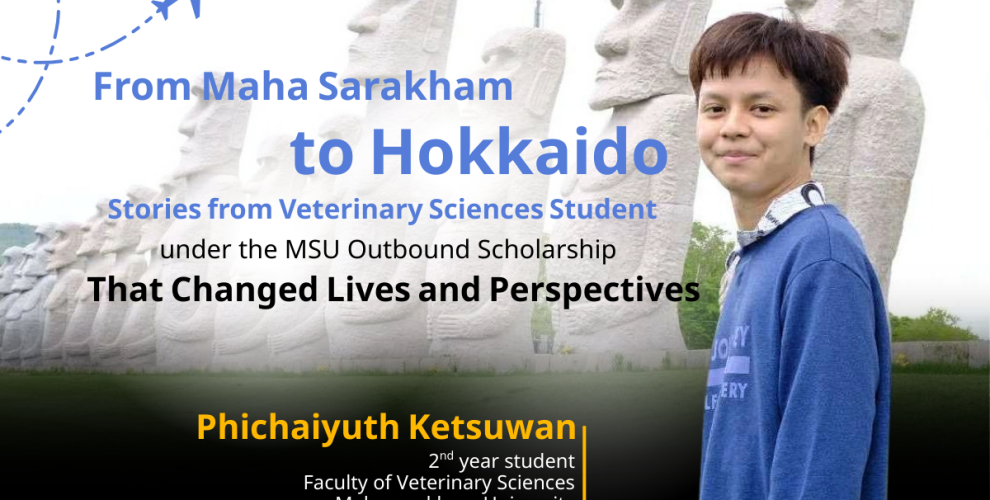
From a young man fascinated by Japanese culture to seizing a life-changing opportunity in veterinary education at Hokkaido University, Japan—Phichaiyuth Ketsuwan, a second-year student at the Faculty of Veterinary Science, Mahasarakham University, is one of the recipients of the MSU Outbound Scholarship. This scholarship not only gave him the chance to experience international research but also became a turning point that shaped his skills, perspectives, and outlook on life—insights that will accompany him throughout his journey to becoming a veterinarian.

Q1: Please introduce yourself and your path in veterinary studies at Mahasarakham University.
Hello, my name is Phichaiyuth Ketsuwan. I am currently a second-year student at the Faculty of Veterinary Science, Mahasarakham University.
Q2: What were the main reasons you chose to study veterinary medicine at Mahasarakham University?
The Faculty of Veterinary Science at Mahasarakham University is accredited by the Veterinary Council of Thailand without conditions. In addition, the faculty accepts a relatively small number of students each year, which creates a close and supportive environment within each class. This atmosphere of learning is something I truly value, and it was a key reason why I chose to study here.

Q3: What inspired you to apply for the MSU Outbound Scholarship?
I once saw a senior from the Faculty of Veterinary Science receive this scholarship to do an internship in Japan. That made me want to pursue the same opportunity. Personally, I have loved Japan since childhood, as I grew up during a time when Japanese culture strongly influenced Thailand in many ways. When I learned about this scholarship and read the requirements, I found that I was eligible, so I decided to apply.
Q4: Could you share your internship experience at Hokkaido University? What did you learn?
I did my internship at the Department of Reproductive and Developmental Biology, Faculty of Science, Hokkaido University. I learned various molecular biology research techniques, such as different types of PCR, collecting samples from experimental animals to extract DNA and RNA, and analyzing experimental results.

Q5: What special skills or lessons did you gain from Japan that you could not get from classrooms in Thailand?
The most obvious one is scientific analytical thinking. Experimental results do not always turn out as expected, and professors there taught me to think systematically through the scientific process—for example, identifying causes of discrepancies, pinpointing errors, and finding new solutions.
In Thailand, classroom learning still faces certain limitations, such as large class sizes, limited time for experiments, and insufficient equipment. Often, this means we only watch demonstrations without the chance to practice hands-on, which makes it harder to fully understand the real purpose of the experiments.
Q6: How is the learning and working culture in Japan different from that in Thailand?
The Japanese place great importance on punctuality—arriving late to the lab, even by a second, is not acceptable. They also take their work very seriously and do not usually greet or chat casually like Thai people do, because they highly respect personal privacy. However, if you take the first step to start a conversation, they are willing to open up and talk with you.

Q7: In what ways has this scholarship helped you grow the most, both academically and personally?
This scholarship greatly improved my social skills. I used to be someone who hesitated to start conversations. But while living in Japan, especially in Sapporo, where society is highly individualistic, I realized that if I wanted a meaningful life, I had to build connections myself. So, I started with small conversations, which brought me new inspiration and taught me that “relationships are bridges that always take us farther than we could go alone.”
Q8: Would you like to share your impression of Mahasarakham University’s support?
The MSU Outbound Scholarship covered almost every expense, including airfare, accommodation, visa fees, travel insurance, and even transportation between Mahasarakham and the airport. This greatly reduced my financial burden.

Q9: Is there any life principle or lesson you live by that you would like to share?
I hold on to the saying: “Shoot for the moon. Even if you miss, you will land among the stars.” Once, I worked very hard to win a scholarship abroad but was unsuccessful. However, what I gained from that effort was improved English skills, which later became the foundation that helped me successfully win this scholarship to study overseas.

Q10: If you could describe your time in Japan in just a few words, what would you call it, and why?
“The best moment.” It was my first time abroad, and it changed many things about me. I gained specialized research knowledge, found new inspiration, discovered a clearer path for my future, and built friendships and experiences that I will remember for a lifetime.

Q11: Would you like to share any encouragement or advice for friends who dream of studying abroad?
If you dream of broadening your horizons and gaining new experiences overseas, the MSU Outbound Scholarship is an opportunity you should not miss. Just prepare yourself—both in language skills and cultural understanding—and go out to experience the world for yourself.